Did the Bible really get “edited” in 1946 to target gay people?
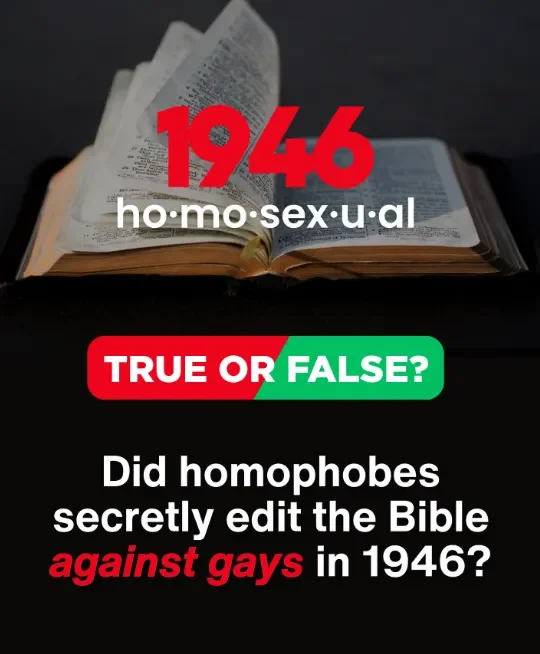
A widely debunked documentary called “1946” has been making the rounds claiming that translators added a prohibition against gay sex to the Bible during a 1946 round of English translation updates.
Here’s the truth: nothing changed about the original text or its translated meaning in 1946.
What did change was the English language and the most common word used to describe people engaging in gay sex.
Let me explain.
It is true that the authors of Scripture didn’t think of gay people as a culturally distinct group or identity.
Actually, sexual identity is a culturally constructed idea, made up by straight people attempting to pathologize same-sex attractions and further marginalize same-sex attracted people as a lesser kind of human.
But, translators in various languages and times have consistently understood Leviticus 18 & 22 + Romans 1 + 1 Cor 6 + 1 Tim 1 collectively to be speaking about people engaging in same-sex sexual activity.
That hasn’t changed.
What did change (in to 80s and after) was that the word “homosexual” in the English language shifted from exclusively meaning “a person who is having gay sex (regardless of sexual orientation)” to “someone who experiences same-sex attractions (regardless of sexual activity)”.
So while the word “homosexual” was a helpful English word to use in 1946, the popular meaning of the English word eventually drifted away from the timeless meaning of the original text.
Today, it’s more true to the original text to translate in self-evident terms such as “men who have sex with men” (as the NIV, CSB, and other modern translations do).
So no, 1946 translators didn’t make up that the bible had something to say about gay sex.
And while there’s plenty of holes a person can poke in arguments that Leviticus 18 & 22 + Romans 1 + 1 Cor 6 + 1 Tim 1 undeniably condemn gay sex, it’s true that these passages collectively…
- condemn playing the passive/receiving role in male gay sex
- condemn playing the active/penetrative role in male gay sex
- condemn female gay sex
- identify same-sex sexual desires as broken
The verses seem to address every possible iteration of same-sex sexual activity and beyond to ensure that the reader is not mistaken.
And yet, none of these passages refer specifically to a committed same-sex couple, and Jesus doesn’t say anything directly about gay sex or gay marriage.
It’d be a lot simpler if, in one of the Gospels, Jesus walked up to two faithful Jews of the same-sex who had somehow gotten married, had been faithful to each other for decades, and were raising children together in the faith, and then Jesus clarified whether that was God’s best for those two believers or not
But we don’t need the clobber passages to know God’s wisdom for gay people, and we don’t need to hear Jesus address gay sex directly to know how Jesus thinks Christians should steward their sexualities.
In a single set of thirteen verses at the beginning of Matthew 19, Jesus lays out the two best paths for Christians, speaks to the sexual difference in Christian marriage, and highlights the importance of vocational singleness as the equal alternative to Christian marriage.
Jesus defines Christian marriage as being a lifetime commitment between one man and one woman, and He urges everyone to consider vocational singleness for the sake of the kingdom, recognizing that for some it would be voluntary but for others it would be involuntary.
God has made clear to us through the Bible what Christian marriage is and that vocational singleness for the sake of the kingdom is the best alternative. These two options are God’s best for His people.
So no, homophobes didn’t rig the Bible in 1946, and God isn’t silent about our sexualities. He’s got good wisdom for us, and it’s worth both studying and following.
Comment/DM “stewardship” for a vid on God’s advice for everyone’s sexuality